Press
Slop Squash press kit
Lockups

Marks



The animated squash


Screenshots
Everything here may be used to write about Slop Squash. Assets are in apps/web/public/press/
and served at https://slopsquash.com/press/<file>; the bundle is https://slopsquash.com/press/slopsquash-press-kit.zip.
Media questions: support@slopsquash.com. Creator and affiliate questions: affiliate@slopsquash.com.
X: @slopsquash.
What Slop Squash is
One line. Slop Squash is a browser extension that flags AI-generated posts, comments and images while you scroll, and tells you why.
Short. Slop Squash is a free Chrome and Firefox extension that checks the posts, pictures and comments on any page for signs of AI generation: cryptographically signed Content Credentials, watermarks such as SynthID where they can be verified, image classifiers, and the way text is written. When something is likely synthetic, a small circle with a bouncing squash appears on it. Tap the circle and it explains the evidence. Pro ($3 a month or $39 once) hides flagged content automatically and can ask a vision model for a second opinion.
Long. Feeds are filling with synthetic images and machine-written comments that most people cannot tell from the real thing. Slop Squash puts a quiet, explainable check on every piece of user content a person sees, in their own browser. It reads provenance data that generators attach to their output (Content Credentials from Google, OpenAI, Adobe, Microsoft and Meta; SynthID where a verifier exists), runs pixel classifiers that attribute images to generators such as Nano Banana, Imagen, GPT and Midjourney even after metadata is stripped, scores writing for machine patterns, and pools verdicts across users so a post checked once is known everywhere. A flag is a best guess, not a verdict: every flag shows its reasons, and users can say "not AI". Slop Squash is free; Pro adds automatic hiding, synced block lists, per-site thresholds and model rechecks. It runs in Chrome and Firefox and is built on Cloudflare.
Facts. Launched 2026. Chrome and Firefox. Free tier with no account required. Pro $3/month or $39 lifetime. Creator program pays 30% commission on referred sales and gives viewers 30% off their first month.
Why it matters (with sources)
- People cannot tell. In a 2025 Royal Society Open Science study, typical adults picked the AI-generated face in a pair only 30% of the time, and even "super-recognisers" managed 41%: both below chance, because AI faces were judged more real than real ones. Five minutes of training on rendering errors raised those figures to 51% and 64%. (Gray, Davis, Bunce, Noyes and Ritchie, Royal Society Open Science, 2025; https://pmc.ncbi.nlm.nih.gov/articles/PMC12606254/)
- Even faces you know. AI images of familiar people are now indistinguishable from photographs: across four experiments, participants could not reliably separate generated images of well-known faces from real ones, even when they knew the person's appearance. (Tree et al., Swansea University, Cognitive Research: Principles and Implications, 2025; https://link.springer.com/article/10.1186/s41235-025-00683-w)
- And people think they can. A 2026 UNSW and ANU study in the British Journal of Psychology found participants only slightly better than chance at spotting AI faces while remaining confident in their answers. The tell is no longer what is wrong with an image but "what is too right": AI faces are unusually average and symmetrical. (https://techxplore.com/news/2026-02-people-overconfident-ai.html)
- The volume is enormous. Google said at I/O 2026 that more than 100 billion pieces of content had been watermarked with SynthID since 2023. Adobe reports more than 24 billion assets generated with Firefly. Industry trackers put cumulative AI images above 30 billion since 2022, and estimates of daily output in the tens of millions; the share of new stock photography that is AI-generated is estimated near a quarter. (Google I/O 2026 keynote; Adobe; https://morphed.app/stats/how-many-ai-images-are-there; https://www.gradually.ai/en/ai-image-statistics/. Daily figures vary widely by source; treat them as estimates.)
- Watermarks alone do not solve it. Since May 2026 every ChatGPT image carries both a SynthID watermark and a C2PA manifest, and Google signs Gemini output the same way. But most social platforms strip metadata on upload, and Google's SynthID verifier is not available to third parties, which is why Slop Squash layers provenance, classifiers, writing analysis and community reports rather than relying on any one signal. (https://openai.com/index/advancing-content-provenance/; https://deepmind.google/models/synthid/)
Brand
Name. Written Slop Squash: two words, each capitalised, in all prose and headings. The one-word form slopsquash appears only in the domain, the X handle and code. Never "Slopsquash", "SlopSquash" in prose, "SLOP SQUASH", "Slop-Squash" or "the Slop Squash extension" (just "Slop Squash").
Logo. The mark is the squash: a terracotta gourd with a sage stem, sitting on a pale circle. Use it in one of two ways:
- The mark alone (
mark.svg,mark-*.png;squash.svgandsquash-*-transparent.pngfor the gourd without its circle, for example as a favicon or on a cream ground). - The lockup: the mark followed by the wordmark "Slop Squash" in Bricolage Grotesque 800
(
lockup-horizontal.svg,lockup-horizontal-*.png,lockup-stacked-*.png).
Never set the wordmark alone without the mark, never recolour the squash, never rotate it (it jumps; it does not tilt), and keep clear space of at least the stem's height around the mark. Minimum size 24px for the mark, 120px wide for the lockup.
The animated squash. squash-jump.gif (512px, cream ground), squash-jump-128.gif,
squash-jump.webp and squash-jump.apng (transparent). This is the same bounce the
extension uses to ask for attention. Loop it; do not slow it down.
Colour.
| Role | Hex | Use |
|---|---|---|
| Cream (ground) | #f5ead8 |
Page and card backgrounds |
| Surface | #ebddc5 |
Secondary panels |
| Ink | #201e1d |
Text, wordmark |
| Terracotta (accent) | #c67139 |
Squash body, primary buttons, links |
| Sage (second accent) | #7a8a5e |
Stem, tags, confirmations |
| Squash pale | #fff2eb |
The circle behind the mark |
| Hero yellow | #ffd631 |
Hero panel and social card |
| Hero orange | #ff711a |
"Squash it." |
| Flag coral | #e8590c |
Confidence bars, the AI verdict |
Type. Headlines and wordmark: Bricolage Grotesque, weight 800, tight tracking. Body: Figtree. Both are open Google Fonts.
Voice. Plain, short, a little dry. "Your feed is full of slop. Squash it." No exclamation marks, no scare language. A flag is a best guess and we say so.
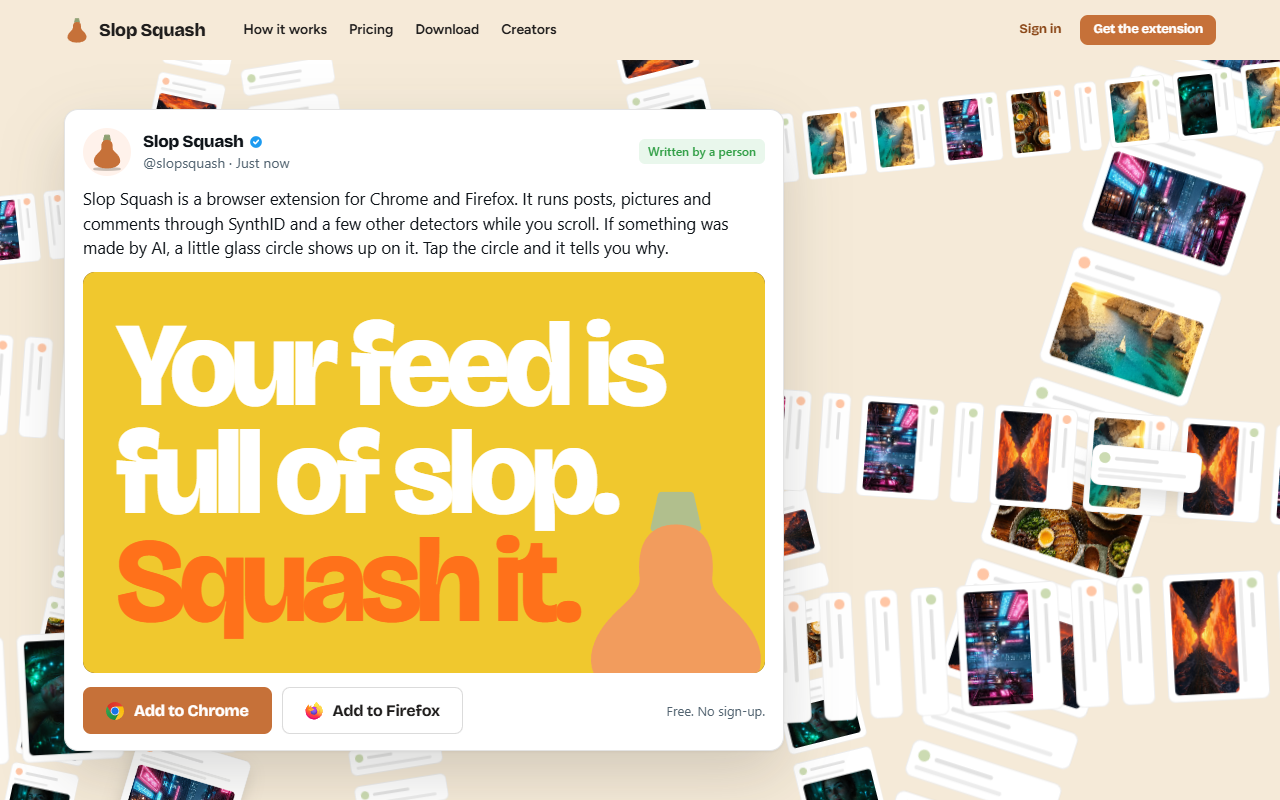
Product screenshots
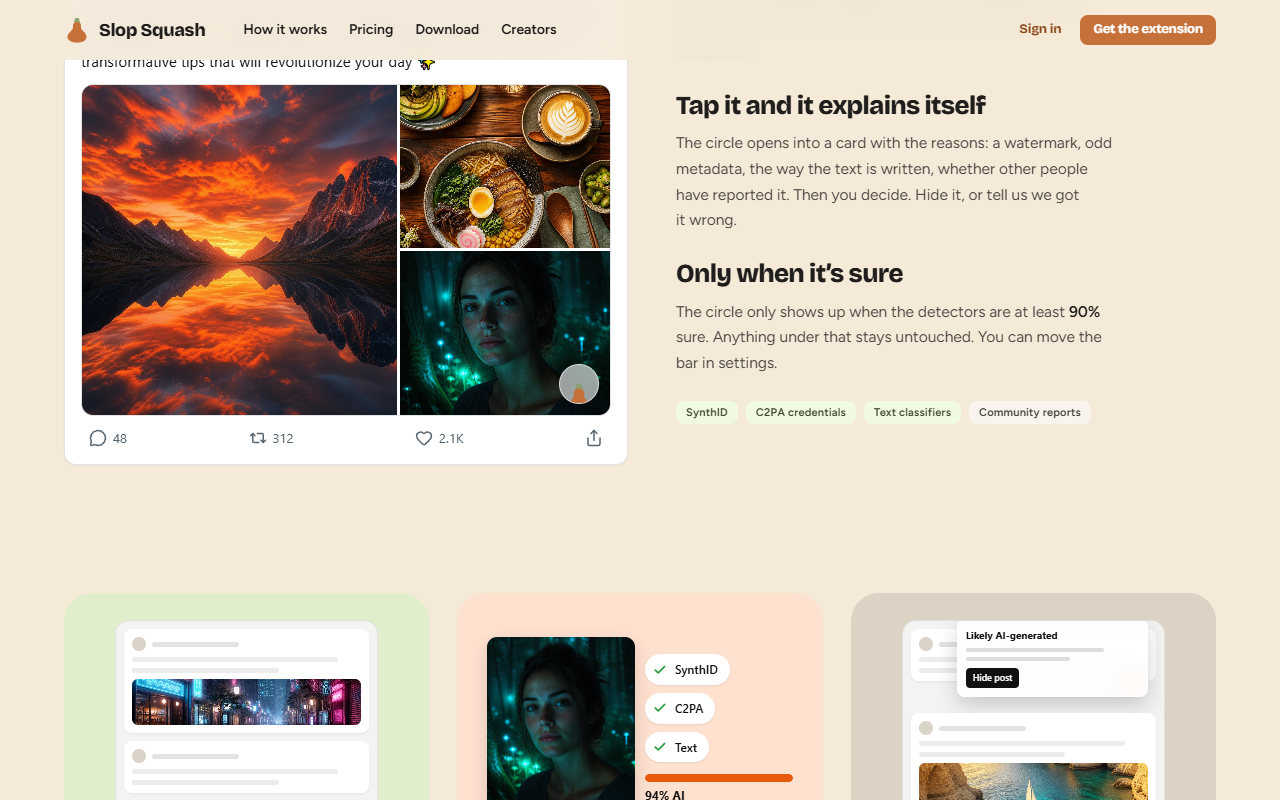
screenshot-home.png (landing page), screenshot-demo.png (the demo post with the flag),
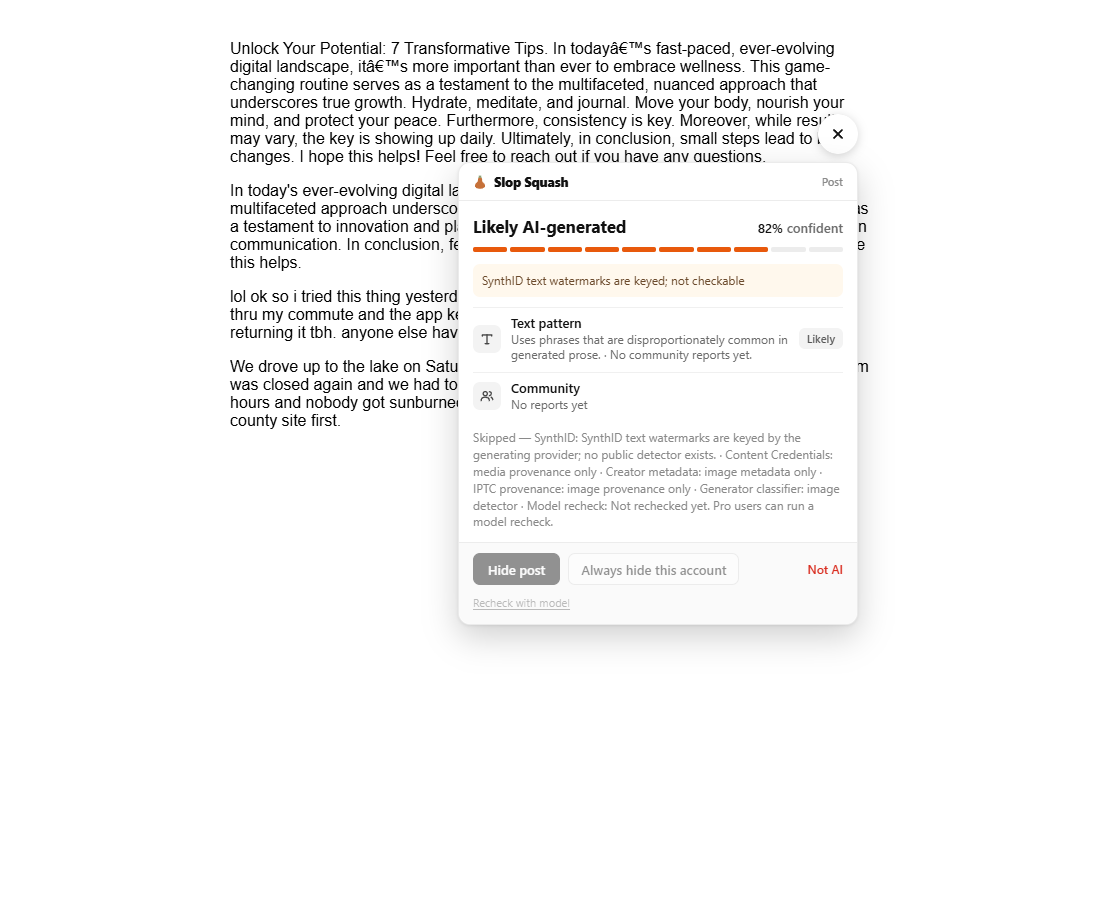
screenshot-extension-modal.png (the extension's explanation card on a real page),
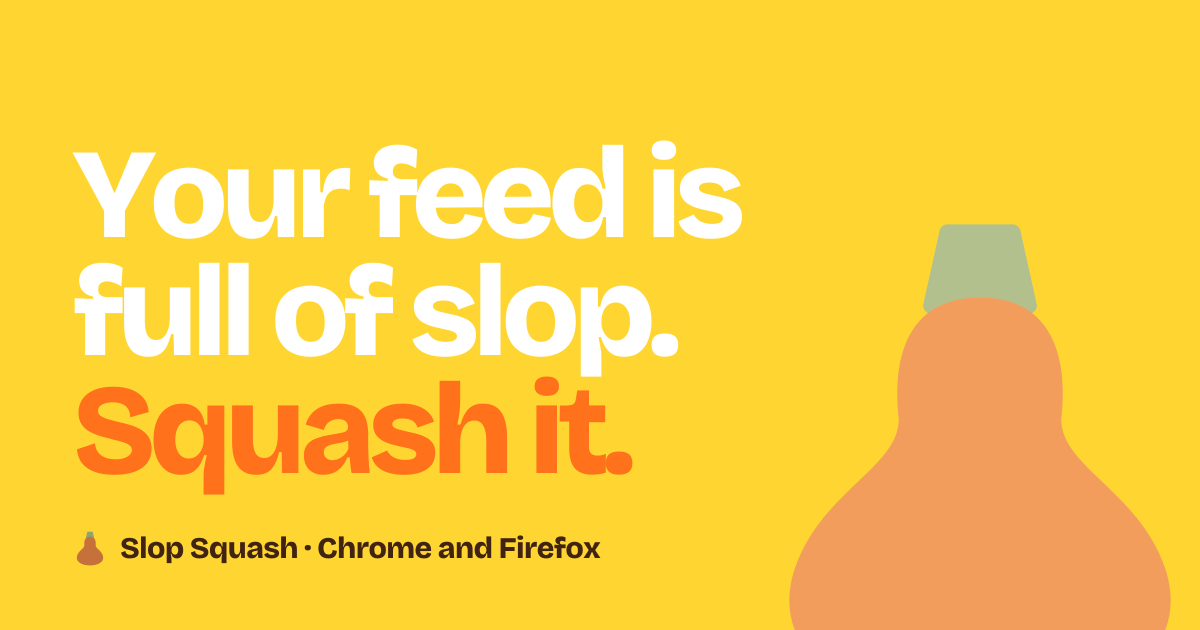
social-card.png (1200x630 share image). Screenshots may be cropped but not altered.
Boilerplate
Slop Squash is a free Chrome and Firefox extension that flags AI-generated posts, comments and images while you scroll, and explains why. It combines Content Credentials, watermark verification, image classifiers, writing analysis and community reports, and shows its evidence on every flag. Pro adds automatic hiding and model rechecks for $3 a month or $39 once. Learn more at https://slopsquash.com.